How-to guide
The One-Page Statement of Work
How freelance designers price changes, protect their time, and keep the client happy
Dani Marsh, a pen name
A whole how-to guide: 69 pages in 7 chapters. Bookbind made it from the brief below and a short author interview, then planned, wrote and typeset every chapter in order, through the same engine and exporter a customer's book goes through.
“A practical guide for freelance designers who keep saying yes to unpaid scope creep”
Inside the book
Contents
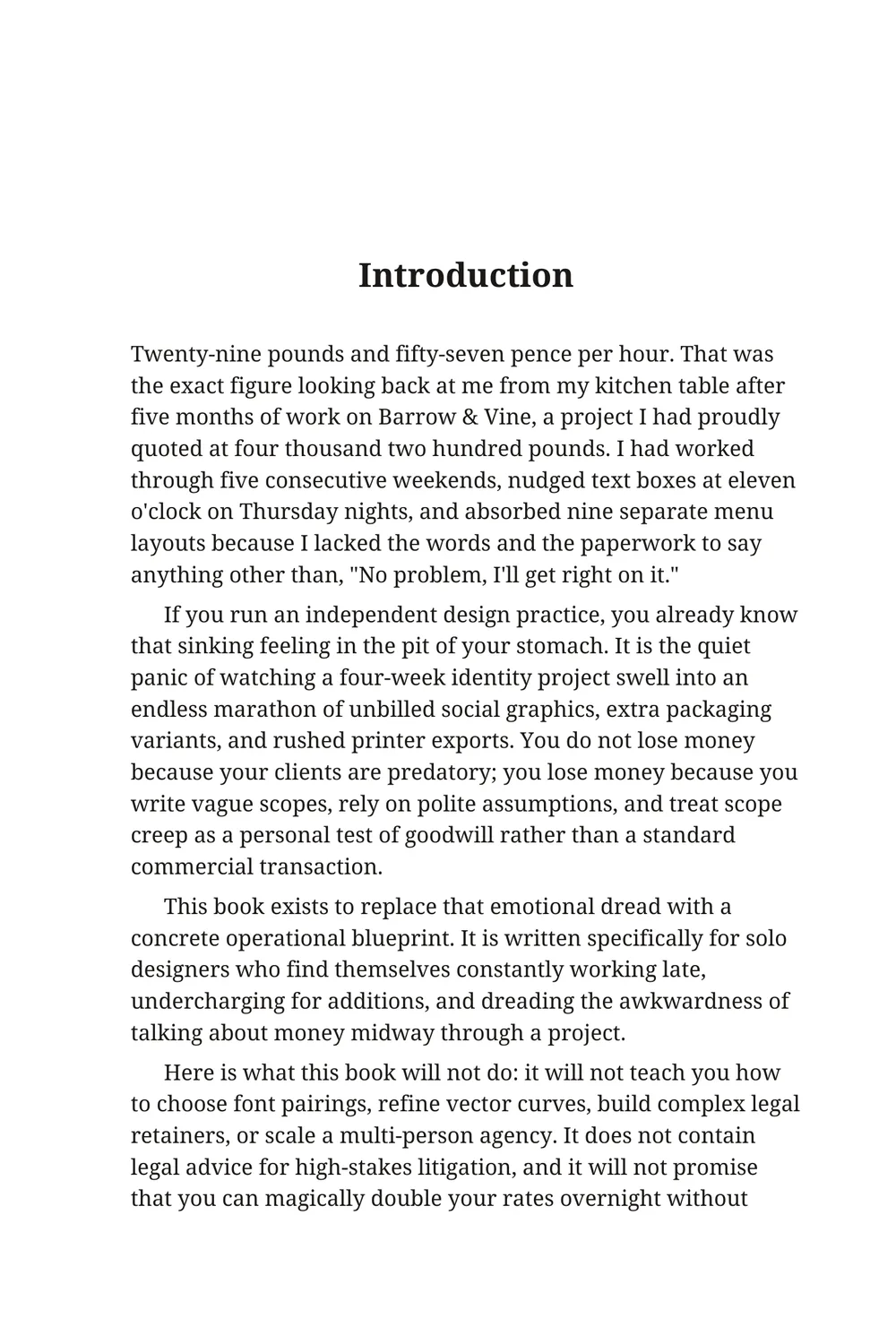
- The Scope Audit: Calculating Your Baseline Deliverable Rate
- Structuring the One-Page Scope: Architecture and Plain-English Rules
- The Four Anatomy Blocks of a One-Page SOW
- The Exclusions Menu and Deliverable Matrix
- Making Pricing Mechanical: The Scope Change Protocol
- Live Call Scripts: Quoting Changes Without Your Stomach Dropping
- The Milestone Closeout and Offboarding Protocol
The opening
Introduction
Twenty-nine pounds and fifty-seven pence per hour. That was the exact figure looking back at me from my kitchen table after five months of work on Barrow & Vine, a project I had proudly quoted at four thousand two hundred pounds. I had worked through five consecutive weekends, nudged text boxes at eleven o'clock on Thursday nights, and absorbed nine separate menu layouts because I lacked the words and the paperwork to say anything other than, "No problem, I'll get right on it."
If you run an independent design practice, you already know that sinking feeling in the pit of your stomach. It is the quiet panic of watching a four-week identity project swell into an endless marathon of unbilled social graphics, extra packaging variants, and rushed printer exports. You do not lose money because your clients are predatory; you lose money because you write vague scopes, rely on polite assumptions, and treat scope creep as a personal test of goodwill rather than a standard commercial transaction.
This book exists to replace that emotional dread with a concrete operational blueprint. It is written specifically for solo designers who find themselves constantly working late, undercharging for additions, and dreading the awkwardness of talking about money midway through a project.
Here is what this book will not do: it will not teach you how to choose font pairings, refine vector curves, build complex legal retainers, or scale a multi-person agency. It does not contain legal advice for high-stakes litigation, and it will not promise that you can magically double your rates overnight without doing the underlying operational work.
By the end of this book, you will be able to write and send a clean, one-page Statement of Work that explicitly limits your deliverables, mechanically prices every change request without confrontation, and ensures you are paid in full before final production files leave your studio.
The Scope Audit: Calculating
Your Baseline Deliverable Rate
On a Tuesday morning in the middle of October, I sat at my kitchen table with a cold cup of filter coffee, staring at a spreadsheet that made me feel physically sick. Three days earlier, I had sent the final export package for a cafe and wine bar called Barrow & Vine. The project had started in June with a tidy, confident proposal for four thousand two hundred pounds. My proposal promised a complete visual identity, packaging stamps, window vinyl graphics, and what I had casually described in an email as a core print collateral suite. At the time, that felt like a generous, professional, and very adult sum of money for what I estimated would be fifty hours of design work spread over six weeks. Fifty hours against four thousand two hundred pounds worked out to an agreeable baseline of eighty-four pounds an hour.
The final invoice had been paid promptly, but my bank account looked depleted, my back ached, and I had spent the preceding five weekends working under a desk lamp while my partner went to the cinema alone. I opened Toggl, exported the time logs for Barrow & Vine, and pulled up my sent mail folder to match the timestamps against the project calendar. The time tracker showed one hundred and forty-two hours logged against the project code. When I divided forty-two hundred pounds by one hundred and forty-two hours, the real number stared back at me in black and white: twenty-nine pounds and fifty-seven pence per hour. Once I subtracted my cloud software subscriptions, my studio insurance, and the tax provision I owed to the government, I had spent five months earning substantially less than the barista who was currently pulling espresso shots behind the counter I had spent three weeks branding.
The terrifying part was that Julian, the cafe’s co-founder, had never once yelled at me, threatened to withhold payment, or demanded free work. He was, in fact, lovely. Our kickoff call had been warm, collaborative, and full of mutual enthusiasm for heavy uncoated paper stock and muted olive-green palettes. The bleeding did not happen through dramatic disputes; it happened through polite, one-sentence emails that arrived on Thursday afternoons. The first one asked if we could do a quick evening drinks sheet to match the lunch menu, just so the staff had something clean for the soft launch. I said yes immediately because I wanted to be helpful, and laying out twenty lines of natural wine took only two hours. Four days later, Julian asked if we might split the lunch menu into separate daytime food and weekend brunch layouts to save the servers from explaining the poached egg surcharge. Again, I said yes, telling myself it was simply an adaptation of an existing grid.
By the end of August, that single phrase from my vague proposal—a core print collateral suite—had metastasised into nine distinct editorial layouts. There was the master food menu, the weekend brunch insert, the evening drinks list, the reserve wine card, a seasonal specials clip-on, a folded takeaway coffee leaflet, a laminated allergy guide for the counter, an opening-hours sandwich board, and three variations of wholesale bakery price tags. None of them were individually monstrous, but each one required typesetting, print-bleed verification, two rounds of copy changes from Julian’s business partner, and fresh press-ready PDF exports. I had eaten roughly three and a half thousand pounds of unpaid work, and the worst
The rest is in the 69-page PDF.
Start with this brief or one of your own. Bookbind plans the book, writes it, draws it if it needs pictures, and packs print-ready files for Amazon KDP. You see the whole plan before a credit is spent.