Lead magnet
The Pre-Call Memo
How to establish your competence before the discovery call starts
Priya Raman, a pen name
A whole lead magnet: 37 pages in 6 chapters. Bookbind made it from the brief below and a short author interview, then planned, wrote and typeset every chapter in order, through the same engine and exporter a customer's book goes through.
“A short guide for coaches on what to send a client before the first call so the call can be about them”
Inside the book
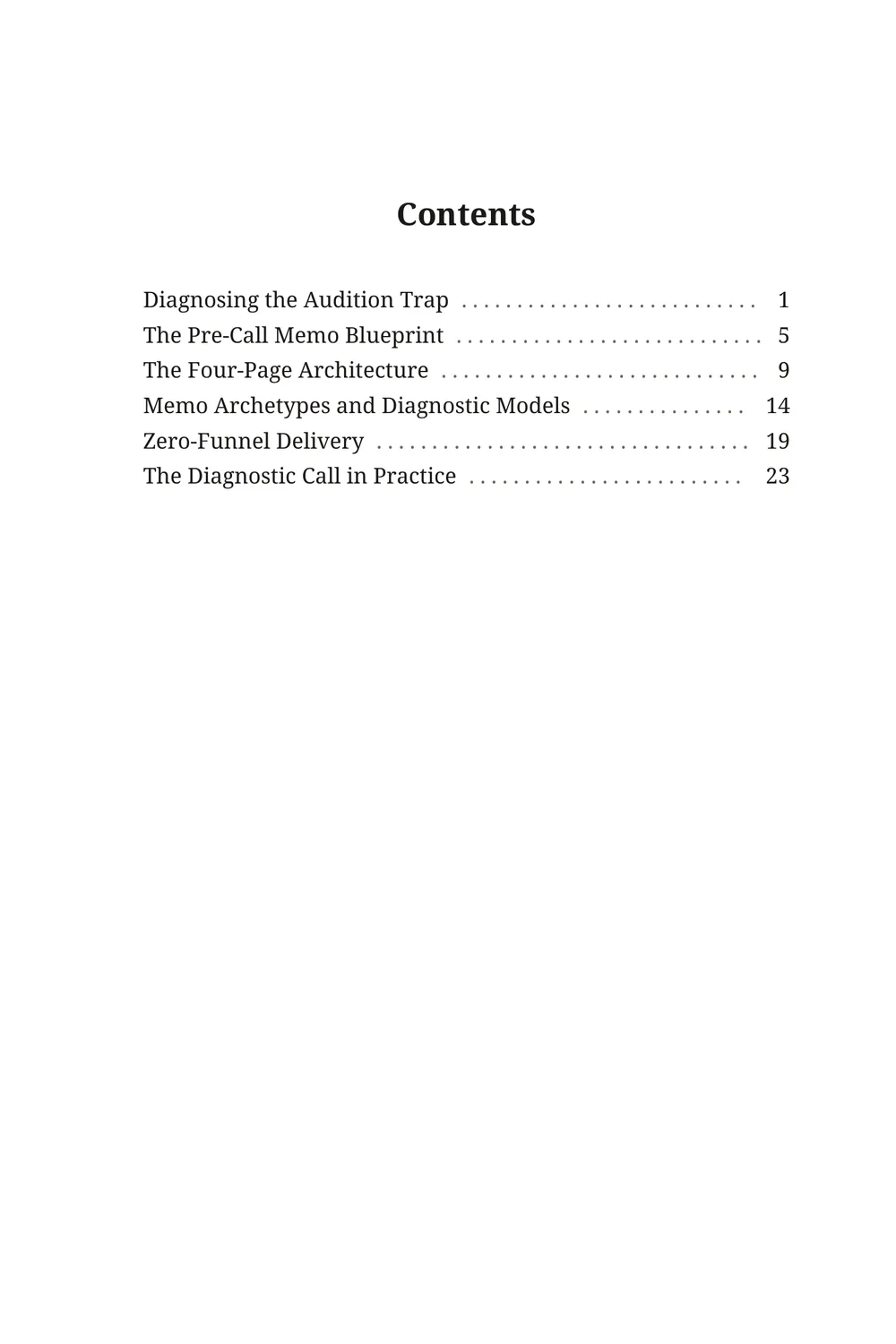
Contents
- Diagnosing the Audition Trap
- The Pre-Call Memo Blueprint
- The Four-Page Architecture
- Memo Archetypes and Diagnostic Models
- Zero-Funnel Delivery
- The Diagnostic Call in Practice
The opening
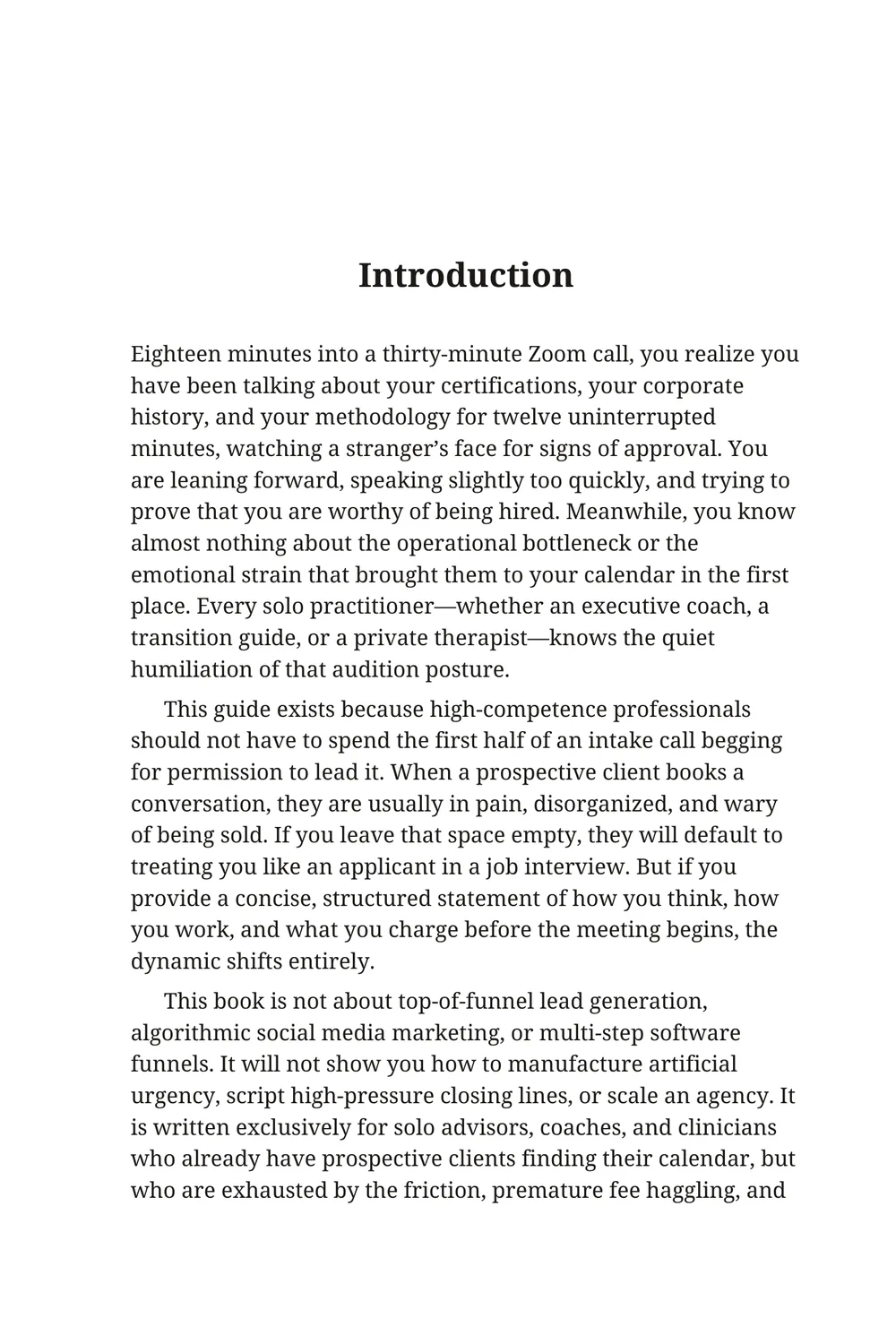
Introduction
Eighteen minutes into a thirty-minute Zoom call, you realize you have been talking about your certifications, your corporate history, and your methodology for twelve uninterrupted minutes, watching a stranger’s face for signs of approval. You are leaning forward, speaking slightly too quickly, and trying to prove that you are worthy of being hired. Meanwhile, you know almost nothing about the operational bottleneck or the emotional strain that brought them to your calendar in the first place. Every solo practitioner—whether an executive coach, a transition guide, or a private therapist—knows the quiet humiliation of that audition posture.
This guide exists because high-competence professionals should not have to spend the first half of an intake call begging for permission to lead it. When a prospective client books a conversation, they are usually in pain, disorganized, and wary of being sold. If you leave that space empty, they will default to treating you like an applicant in a job interview. But if you provide a concise, structured statement of how you think, how you work, and what you charge before the meeting begins, the dynamic shifts entirely.
This book is not about top-of-funnel lead generation, algorithmic social media marketing, or multi-step software funnels. It will not show you how to manufacture artificial urgency, script high-pressure closing lines, or scale an agency. It is written exclusively for solo advisors, coaches, and clinicians who already have prospective clients finding their calendar, but who are exhausted by the friction, premature fee haggling, and performative energy of traditional discovery calls.
By the end of this book, you will be able to draft a four-page pre-call memo and integrate it into your existing booking link so that every prospective client arrives at your discovery call already understanding your method, accepting your boundaries, and ready to be diagnosed.
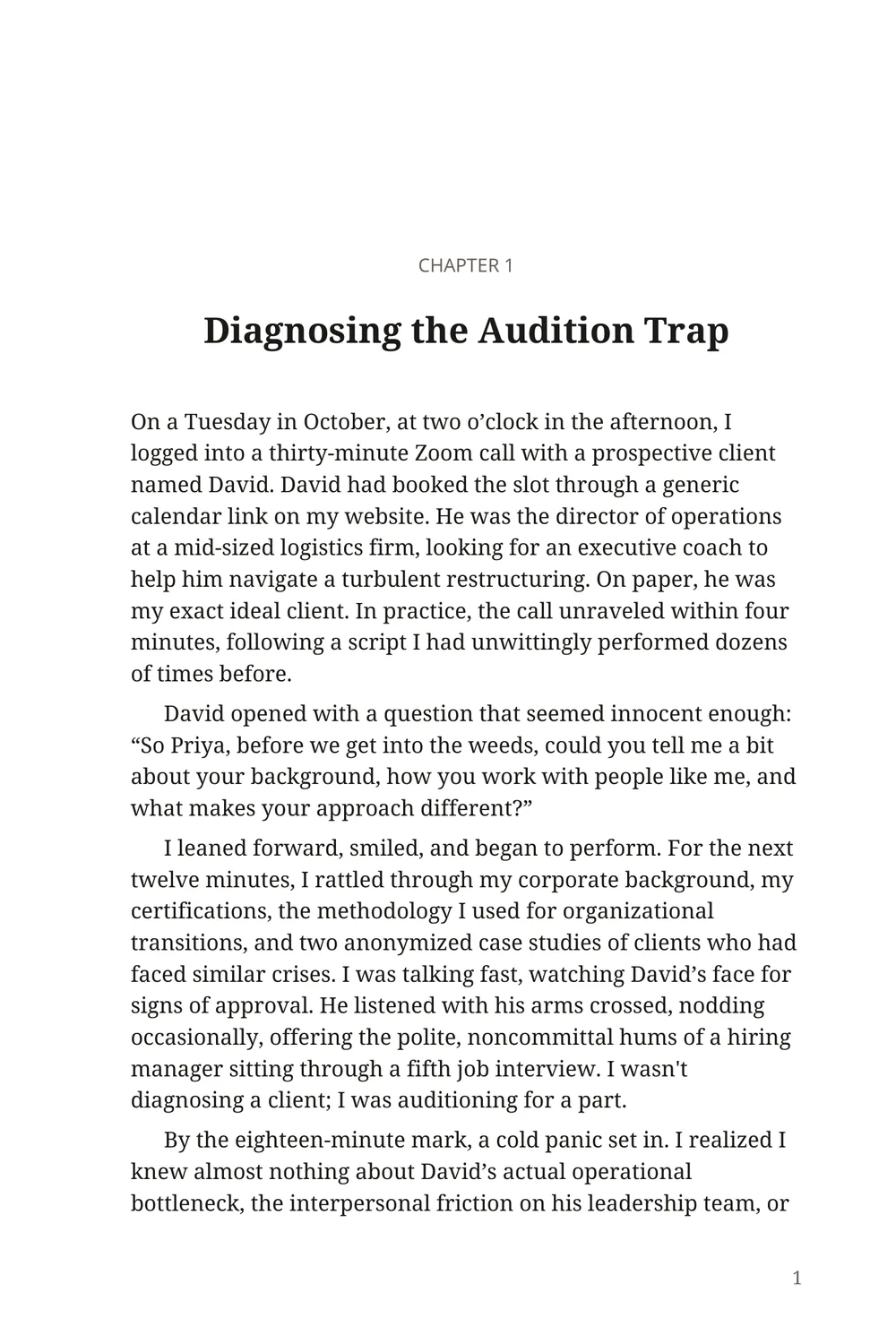
Diagnosing the Audition Trap
On a Tuesday in October, at two o’clock in the afternoon, I logged into a thirty-minute Zoom call with a prospective client named David. David had booked the slot through a generic calendar link on my website. He was the director of operations at a mid-sized logistics firm, looking for an executive coach to help him navigate a turbulent restructuring. On paper, he was my exact ideal client. In practice, the call unraveled within four minutes, following a script I had unwittingly performed dozens of times before.
David opened with a question that seemed innocent enough: “So Priya, before we get into the weeds, could you tell me a bit about your background, how you work with people like me, and what makes your approach different?”
I leaned forward, smiled, and began to perform. For the next twelve minutes, I rattled through my corporate background, my certifications, the methodology I used for organizational transitions, and two anonymized case studies of clients who had faced similar crises. I was talking fast, watching David’s face for signs of approval. He listened with his arms crossed, nodding occasionally, offering the polite, noncommittal hums of a hiring manager sitting through a fifth job interview. I wasn't diagnosing a client; I was auditioning for a part.
By the eighteen-minute mark, a cold panic set in. I realized I knew almost nothing about David’s actual operational bottleneck, the interpersonal friction on his leadership team, or why he had sought help this week instead of six months ago. I abruptly pivoted, trying to steer the conversation back into a diagnostic frame: “Tell me, David, what is the single biggest operational headache you’re facing right now?” But the authority in the room had already shifted. Having spent the first half of the call treating him as an evaluator and myself as the candidate, David treated my question not as an expert intake, but as a sales inquiry. He gave a brief, surface-level answer, checked his watch, and asked, “And what do you charge for a six-month engagement?”
When a practitioner is caught in an audition, pricing always arrives prematurely. Without a shared diagnostic understanding of the problem’s cost, any fee sounds like an arbitrary expense rather than an investment in relief. I stated my fee of four thousand dollars, heard the slight hitch in his breath, and immediately committed the second classic audition error: I began justifying the number. I explained that the fee included unlimited email support, two monthly assessments, and emergency phone access. David nodded politely, smiled, and said the words every solo practitioner comes to dread: “This has been really helpful, Priya. Send me a proposal and let me think about it.” We hung up at minute twenty-nine. I never heard from him again.
That quarter, I ran forty discovery calls just like David’s. I prepared for each one, took extensive notes, performed my credentials with earnest energy, and closed exactly six clients.
The math of that quarter was brutal, but the emotional cost was worse. Running forty unanchored sales calls meant spending twenty hours performing live on camera, and at least double that time recovering from the low-grade humiliation of being evaluated. When you spend forty-five minutes proving you are qualified to help someone, you end the day depleted, resentful, and quietly wondering if your pricing is simply too high or your credentials too thin.
The rest is in the 37-page PDF.
Start with this brief or one of your own. Bookbind plans the book, writes it, draws it if it needs pictures, and packs print-ready files for Amazon KDP. You see the whole plan before a credit is spent.