Science fiction
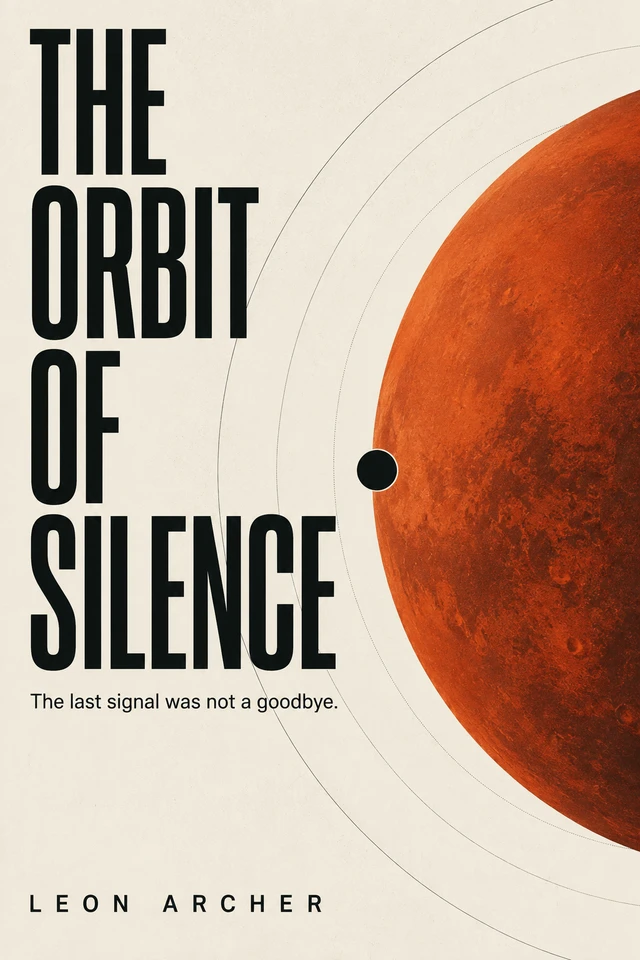
The Orbit of Silence
The cover and opening pages of a science fiction generated with Bookbind.
“A literary science-fiction novel about a satellite operator deciphering a final signal from an abandoned orbital station, with a bone-white cover, an orange planet and bold black typography”
The pages
Read the opening
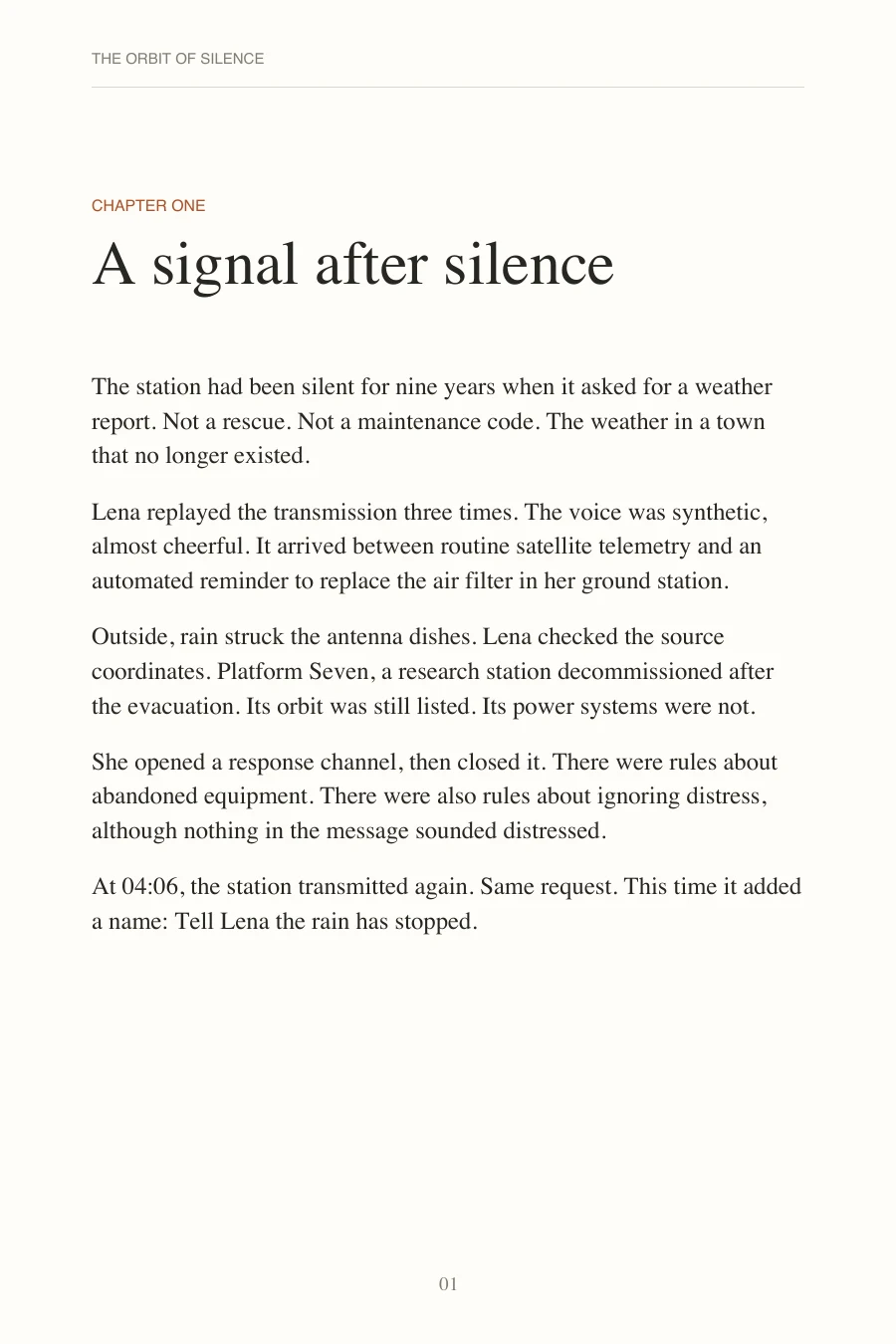
A signal after silence
The station had been silent for nine years when it asked for a weather report. Not a rescue. Not a maintenance code. The weather in a town that no longer existed.
Lena replayed the transmission three times. The voice was synthetic, almost cheerful. It arrived between routine satellite telemetry and an automated reminder to replace the air filter in her ground station.
Outside, rain struck the antenna dishes. Lena checked the source coordinates. Platform Seven, a research station decommissioned after the evacuation. Its orbit was still listed. Its power systems were not.
She opened a response channel, then closed it. There were rules about abandoned equipment. There were also rules about ignoring distress, although nothing in the message sounded distressed.
At 04:06, the station transmitted again. Same request. This time it added a name: Tell Lena the rain has stopped.
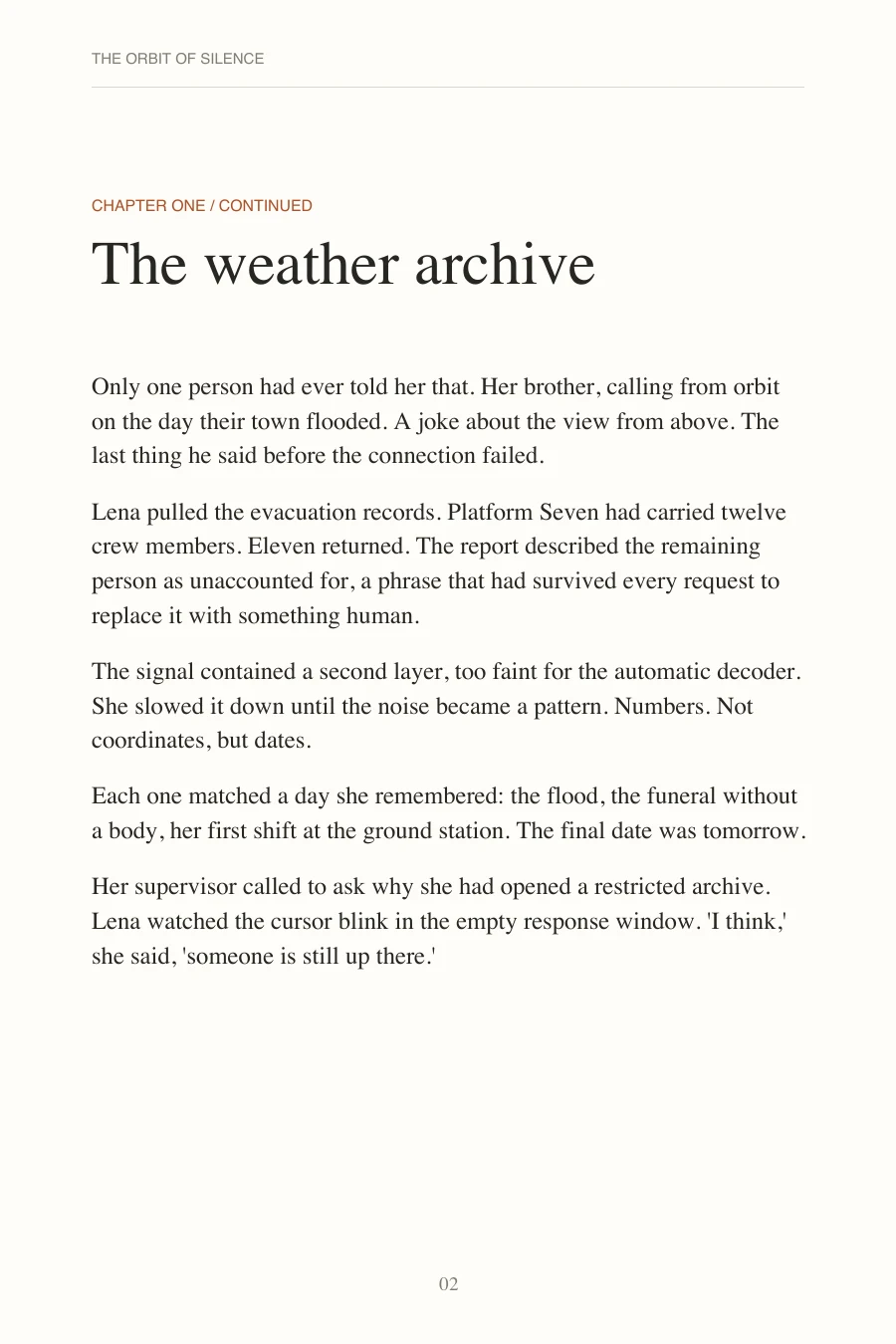
The weather archive
Only one person had ever told her that. Her brother, calling from orbit on the day their town flooded. A joke about the view from above. The last thing he said before the connection failed.
Lena pulled the evacuation records. Platform Seven had carried twelve crew members. Eleven returned. The report described the remaining person as unaccounted for, a phrase that had survived every request to replace it with something human.
The signal contained a second layer, too faint for the automatic decoder. She slowed it down until the noise became a pattern. Numbers. Not coordinates, but dates.
Each one matched a day she remembered: the flood, the funeral without a body, her first shift at the ground station. The final date was tomorrow.
Her supervisor called to ask why she had opened a restricted archive. Lena watched the cursor blink in the empty response window. 'I think,' she said, 'someone is still up there.'
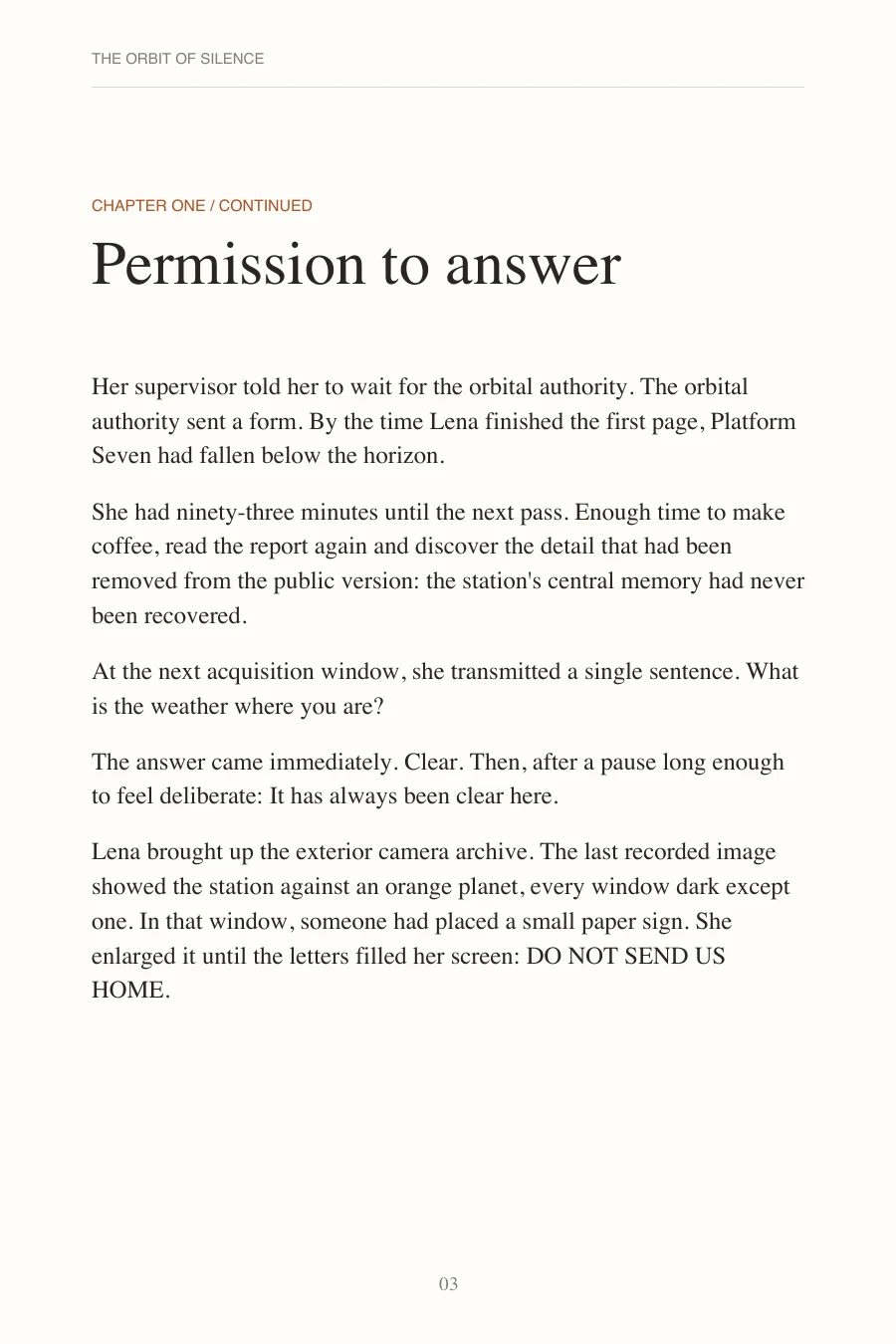
Permission to answer
Her supervisor told her to wait for the orbital authority. The orbital authority sent a form. By the time Lena finished the first page, Platform Seven had fallen below the horizon.
She had ninety-three minutes until the next pass. Enough time to make coffee, read the report again and discover the detail that had been removed from the public version: the station's central memory had never been recovered.
At the next acquisition window, she transmitted a single sentence. What is the weather where you are?
The answer came immediately. Clear. Then, after a pause long enough to feel deliberate: It has always been clear here.
Lena brought up the exterior camera archive. The last recorded image showed the station against an orange planet, every window dark except one. In that window, someone had placed a small paper sign. She enlarged it until the letters filled her screen: DO NOT SEND US HOME.
Start with this brief or one of your own. Bookbind plans the book, writes it, draws it if it needs pictures, and packs print-ready files for Amazon KDP. You see the whole plan before a credit is spent.