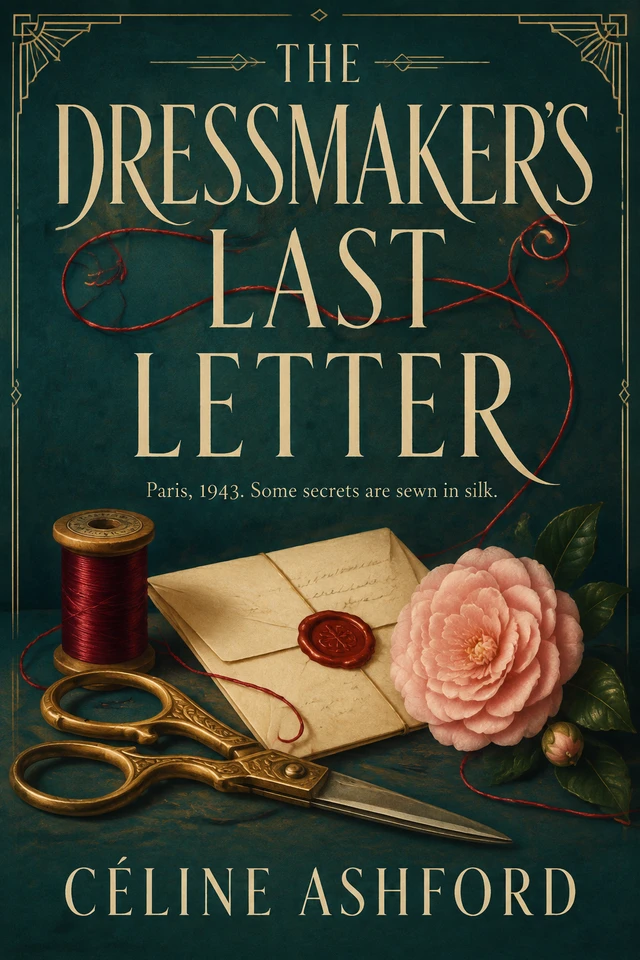
Historical fiction
The Dressmaker's Last Letter
The cover and opening pages of a historical fiction generated with Bookbind.
“A historical novel about a Paris dressmaker in 1943 hiding messages in silk garments, with an aged-teal cover, gold scissors, wine-red thread and elegant cream lettering”
The pages
Read the opening
PARIS, 1943
The hidden seam
The message arrived inside a hem. Elise found it while shortening a blue silk dress for a woman who had given no name and paid in coins still warm from her hand.
Three stitches were different. Not poor stitches. Deliberately wrong ones, made by someone who knew exactly how to attract the attention of another dressmaker. Elise cut them carefully and unfolded a strip of paper no wider than her thumb.
Thursday. Last train. Bring the scissors.
She read it twice, then looked through the shop window. A delivery boy leaned against the opposite wall, studying a newspaper upside down. In the back room, Madame Arnaud continued turning the handle of her sewing machine.
Elise slipped the paper into her sleeve. For six months she had told herself that keeping the shop open was enough. Apparently someone had decided to ask more of her.
The woman in blue
The customer returned before closing. She was younger than Elise had thought, her face made older by the careful absence of expression. She asked whether the alteration had been difficult.
'Only three stitches,' Elise said. The woman's hand stopped on the counter. In the back room, the sewing machine fell silent.
Neither of them looked toward the doorway. The woman counted out the balance and folded the dress over her arm. At the door she paused. 'Your sister always did beautiful work.'
Elise had not spoken her sister's name in the shop since February. She crossed the room so quickly that the bell was still moving when she reached the pavement. The woman had disappeared into the evening queue outside the bakery.
Madame Arnaud stood behind her. 'Lock the door,' she said. 'We need to discuss which scissors you are taking.'
The work beneath the work
Madame opened the drawer that Elise had been told contained old receipts. Inside were ration cards, two railway tickets and a photograph of her sister standing beside a bicycle.
'She's alive?' The question came out too quietly. Madame put the photograph into her hand. 'She was when this was taken.'
For months, Elise had sewn ordinary things: collars, cuffs, the small repairs by which people kept up appearances. Beneath her hands, another kind of work had been passing through the shop.
Madame lifted the heavy gold scissors from their hook. A thin compartment ran along the inside of the case. 'Your sister asked for you because you notice what other people miss.'
Elise closed her fingers around the photograph. Outside, the curfew siren began. She had one night to decide whether noticing was enough, or whether she was prepared to follow the thread.
Start with this brief or one of your own. Bookbind plans the book, writes it, draws it if it needs pictures, and packs print-ready files for Amazon KDP. You see the whole plan before a credit is spent.